
FIFA 14 is out, we’ve all had a go at it, and it’s pretty good, right? Lots of nice changes, some big, some small. Those new skill games are pretty cool. I quite like some of the new animations. But come on, that’s not why we play it – we want to scout. The next Messi isn’t going to find himself. So here it is, the FIFA 14 scouting guide.
Contents
- Choosing a scout
- Where to look
- Spotting a great player on your reports
- After you’ve promoted players & the May update
- Other tips and info
- Summary
Once again EA have stuck with what they know and kept the scouting system largely similar to last year’s effort. There are a couple of changes here and there, and I’ll run through them in this article. But first of all, let’s have a look at what you can expect from scouts, as well as the basics of hiring a scout and packing him off to look for emerging youth talent.
To hire a scout, go to the Office tab, then click on Youth Staff. There will be three slots available for hiring new scouts, so click on one of these and you will be presented with a list of five scouts to choose from, all of varying prices and abilities.
Like last year, you will have a couple of scouts from the nation in which your team plays (e.g. Spain if you’re doing a Real Madrid career). There will also be a few other scouts, all of which will be from a similar part of the world. If you don’t like the look of any of the scouts, advance to the next Sunday and they will have changed.
However, this is where it’s slightly different to previous years. The scouts will almost always be from your ‘home region’. That is, if your team is from Spain, you will have a selection of scouts from southern Europe – defined in the game as including Croatia, Greece, Italy, Portugal, Spain and Turkey. If you hire one of these scouts, they are replaced by a scout from the next region in a pre-defined cycle. The regions rotate by a specific order, namely: Northern Europe, Southern Europe, Central Europe, Eastern Europe, Asia, Oceania, Africa, South America, North America, before returning to Northern Europe. In previous versions of the game the regions would simply rotate every week; now you have to buy a scout to make this happen.
Furthermore, the process can get reset when you get to a Sunday. If you start with Southern Europe and want to get a scout from North America, you’ll have to have start on Monday and have two scout vacancies to hire and fire scouts. Hire two scouts, then fire them as soon as they arrive and hire the two new scouts who replaced them (they will be from the next two regions in the list). You need to start early in the week because when you get to Sunday the process resets – if you hire a South American scout on Friday, by the time he’s arrived and ready to be fired on the Sunday the order will have been reset, so his replacement will be from Southern Europe (if that’s your home region). Annoying, but something to bear in mind.
Yet unlike the previous two years, sending a scout to his own country doesn’t seem to give you any tangible bonus (or if it does, it’s so minor as to make no real difference). So if you want to find the next Brazilian superstar, you shouldn’t need to worry about rotating the scouts to get a Brazilian one; a high-rated one from any nation should still be excellent and you’ll save money on hiring scouts. And although you can’t send two scouts to the same country at the same time, because there is no ‘home nation bonus’ you won’t lose out if all your scouts are from the same place.
What does matter, however, is the scout’s rating in both experience and judgement. But what do each of these mean? Last year user Lelouch pointed out that a scout’s judgement rating affects his chances of finding the best players in the following way:
| Stars | Bronze | Silver | Gold | Platinum |
|---|---|---|---|---|
| 1 | 75% | 17% | 5% | 3% |
| 2 | 67% | 22% | 7% | 4% |
| 3 | 50% | 36% | 9% | 5% |
| 4 | 30% | 52% | 11% | 7% |
| 5 | 20% | 53% | 17% | 10% |
Here’s what I said about it last year:
This table refers to a scout’s odds of finding good players based on his judgement rating (as opposed to the odds of finding good players in any given region). The first number represents the number of stars the scout has for his judgement rating. The next four numbers show the percentage of player qualities each scout will find (bronze being the worst players, platinum being the best). So a scout with 1 star for judgement will have a 75% chance of finding bronze players, a 17% chance of finding silver players, a 5% chance of finding gold players and a 3% chance of finding platinum players. I don’t know exactly how good a bronze player is compared to a platinum player (i.e. where the boundaries are set), but platinum players will certainly be much, much better.
Experience, on the other hand, refers to how likely the scout is to find the type of player you’re looking for. So if you just specify “Any” as the player type then the scout’s experience rating doesn’t even matter!
Another thing to bear in mind is that sending better scouts on trips will now cost you more money than sending lower rated ones out. Here are some example figures for scouts of varying abilities:
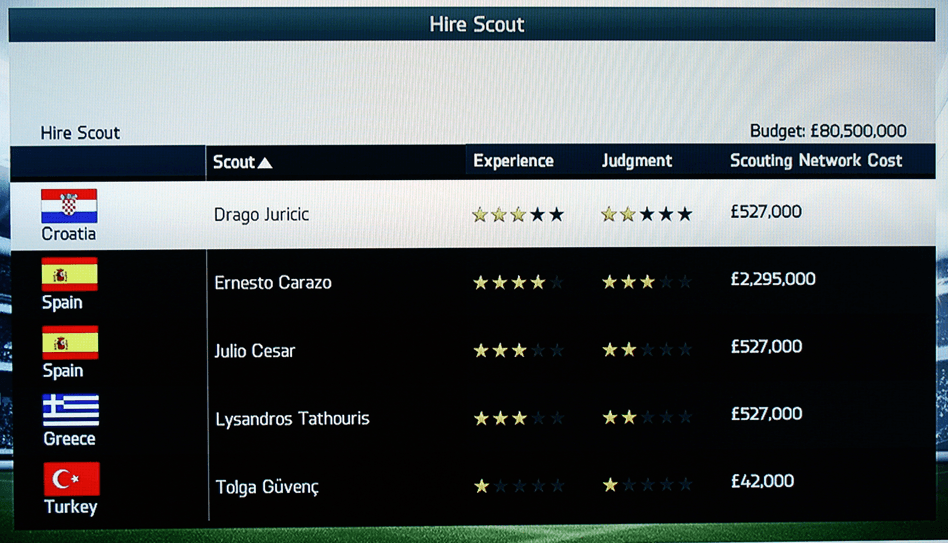
A range of scouts to choose from
- 5*/5* scout
- 3 months: £102,000
- 6 months: £204,000
- 9 months: £306,000
- 3*/3* scout
- 3 months: £82,000
- 6 months: £163,000
- 9 months: £245,000
- 1*/1* scout
- 3 months: £61,000
- 6 months: £122,000
- 9 months: £184,000
So there is a bit of a difference. However, I would definitely advise you to get the best scout you can afford to. The higher the scout rating, the more players he will bring back for you and therefore the better your chances of finding a great player. 1*/1* scouts are not exactly great – that’s not to say that it’s impossible to get good players with them, but you could be waiting a very long time, seeing as they find fewer players (two or three new players per month as opposed to four, five or six for a 5*/5* scout) and those that they do find are, on average, of an inferior quality. It also takes a lot longer for lower-rated scouts to pin down a player’s type and position. Ultimately, you could very well find the next Ronaldo with a 1*/1* scout – it is definitely possible – but you have to have a lot of patience.
One of the first things you’ll notice when deciding where to look for talent is that trips to different regions will cost different amounts. For example, this is how much a three month trip would cost by region:
- Northern Europe: £48,000
- Southern Europe: £97,000
- Central Europe: £97,000
- Eastern Europe: £48,000
- Asia: £16,000
- Oceania: £16,000
- Africa: £97,000
- South America: £97,000
- North America: £48,000
However, I wouldn’t necessarily say this simply means that the most expensive places will produce the best talent. In the last two versions there was actually an algorithm the game used to determine this, which user MTGowns pointed out. I’ve posted it below:
And about the country output, you can access the file that dictates the chances of finding certain tiers of players – there are four: Bronze, Silver, Gold and Platinum. Naturally, Platinum are the best youngsters out there. Each set of regions have different probabilities for each kind of player. As found in youth_scout.ini the odds are:
YOUTH_PLAYER_PLATINUM_0=15
YOUTH_PLAYER_PLATINUM_1=5
YOUTH_PLAYER_PLATINUM_2=2
YOUTH_PLAYER_PLATINUM_3=6
YOUTH_PLAYER_PLATINUM_4=14
YOUTH_PLAYER_PLATINUM_5=8
YOUTH_PLAYER_PLATINUM_6=13
YOUTH_PLAYER_PLATINUM_7=7
YOUTH_PLAYER_PLATINUM_8=3
YOUTH_PLAYER_PLATINUM_9=1
YOUTH_PLAYER_PLATINUM_10=1
YOUTH_PLAYER_PLATINUM_11=6Where each number is:
// 0 = SUBREGION_ARGENTINA_BRAZIL,
// 1 = SUBREGION_REST_OF_SOUTH_AMERICA,
// 2 = SUBREGION_NORTH_AMERICA,
// 3 = SUBREGION_NORTHERN_EUROPE,
// 4 = SUBREGION_ITALY_SPAIN_PORTUGAL,
// 5 = SUBREGION_REST_OF_SOUTHERN_EUROPE,
// 6 = SUBREGION_CENTRAL_EUROPE,
// 7 = SUBREGION_REST_OF_EUROPE,
// 8 = SUBREGION_JAPAN_CHINA,
// 9 = SUBREGION_REST_OF_ASIA,
// 10 = SUBREGION_AUSTRALIA,
// 11 = SUBREGION_AFRICA,So it can be seen that Argentina, Brazil, Italy, Spain, Portugal and every Central European country (including Switzerland and Austria!) is where you’re the most likely to find elite youngsters. On the other hand, it’s quite unlikely you’ll find an EPL star in Australia, Asia or North America and you’ll be better off looking elsewhere!
So the higher the number after the = sign, the better your chances of finding top players. Interestingly, even though Southern Europe is one of the most expensive regions to scout, results from Italy, Spain and Portugal should be markedly better than from the rest of that region because those three nations have a rating of 14 on the above chart, whilst Croatia, Greece and Turkey only have a rating of 8 (i.e. “Subregion rest of Southern Europe”). Don’t be put off too much, though – you can get great players from anywhere, but as this list shows, some regions are more likely to produce top talent than others.
Because the scouting system in FIFA 14 is based on the same core as the FIFA 13 scouting system, this should still apply. However, I don’t have direct access to the game code for FIFA 14 so I can’t confirm whether this is still the case, but I suspect it is. Perhaps someone who does have access to it would be able to confirm it – if you do know, be sure to leave a comment below.
However, what I am sure of is that, like previous years, certain regions do not specialise in certain player types. I sent three scouts to Spain, a country renowned for its technically gifted players, but the best player I found there was actually a goalkeeper, and I found very promising players with a wide variety of player types.
So if you want a good defender, don’t go looking in Italy because you think they traditionally produce good defenders; rather, send your scout to one of the top countries listed above. You may well find good defenders in Italy, but that’s because the game says they will produce good players of any type, not because they ‘specialise’ in defenders.
Of course, you can find great players in any country; you just have less of a chance of doing this if you look in, say, Serbia than if you look in Brazil. But it is totally possible to find a real gem in a minnow country, so don’t give up on them totally.
3. Spotting a great player on your reports
When your scout brings back his report, you will see a list of potential players to sign to your academy. They will most likely be 15 or 16; it now seems to be impossible to find 14 year olds. They will have an OVR range (e.g. 44 – 58) and a potential range (e.g. 67 – 89). There are also similar ranges for a few of the player’s stats. These ranges basically mean that your scout is estimating how good the player is, and how good he could potentially grow to become. The same is true for the attribute ranges – if a player’s strength range is 43 – 85, this doesn’t mean it is currently 43 and can grow to become 85; what it means is that your scout thinks the player’s strength value is somewhere between those two numbers. The longer your scout watches a player, the narrower these ranges become. As time goes on your scout is also able to pin down his position and player type, but beware – other teams can move in and sign these players to their own academies. So if you like the look of a player (and have the £21,000 signing fee) then move quickly for them!
Anyway, good players will have an upper potential range (e.g. the 89 in 67 – 89) in the late 80s or 90s. The very best players will have a minimum potential value of at least 70 (e.g. 73 – 94). These are the ones you should move for straight away. But if you’re not sure whether a player will be good enough, simply find the middle of the potential range – so for this example, the middle of 67 – 89 would be 78. This isn’t a foolproof way to work out a player’s actual potential, but it’s a simple way to get a rough estimate. If that middle number looks good enough for your team, sign the player.
Let’s have a look at some examples of players I would and would not sign to show you what I mean:

This player’s OVR doesn’t look very good (especially compared to FIFA 13), but look at his potential. We can take a rough guess that his actual potential is around 83, which is very good. What I would do in this case is sign the player and then wait until the May update; chances are his OVR will go right up and he will be well worth the investment. Now let’s have a look at a player who I probably wouldn’t sign:

His OVR range is actually higher than the last player, but his potential range is nowhere near as good – we can assume his actual potential is around 74. Come May he may not actually grow that much (at least, compared to the last player) because his potential is probably lower. Of course, you may find that this player would fit in well with your team and could make a real difference; if that’s the case, definitely go ahead and sign him. But you can expect to (hopefully) find better players than this.

Now I don’t think I need to tell you whether to sign this beast or not! When you find a player like this and the minimum potential value is already so high, it quite often goes higher. So while we could guess his potential is around 85, in next month’s scout report his potential range may have changed to 81 – 94 or something similar. These are the very best players out there and are not to be missed.
If you want to find players like this, it’s actually fairly straightforward: as with the past two years, you can still reload scouting reports. Just save the day before the scouting report is due to arrive, then advance to the next day. Open up the scouting report, and if there’s no one there that looks good enough, just quit the career and reload it. Advance again and the players on your scouting report will be different. You may not want to do this, and that’s fair enough. You will still be able to find great players without doing this, it will just save time.
Last year there were five or six ‘sets’ of scouting reports, so if you reloaded enough you would get the same set of players come up more than once. This year (I’m almost certain) this no longer happens, and that scouting reports are random (or if there are sets, there are a lot more than five or six).
4. After you’ve promoted players & the May update
As with FIFA 13, youth players only grow once per year (1st May), so it is vital that you wait until then in order to maximise your youth players’ growth. If you promote a youth player in April then you essentially lose an entire year’s worth of growth. If you wait until May, he often ends up growing a massive amount. Whilst this was true for FIFA 13, it is even more the case this year because it seems to be much, much harder to find youth players with 65 OVR or higher right off the bat – you usually have to wait until May for them to reach this sort of OVR.
For example, in my test career I had three particularly promising players (the first was found by a 3*/3* scout, the second two with a 4*/5* scout). Below are their stats when they were first scouted:
- One was rated 52-70, potential 76-94
- One was rated 47-63, potential 77-94
- One was rated 47-63, potential 72-94
As a test I promoted them as soon as possible, and they came out rated 54, 54 and 51 respectively, which was pretty disappointing to be honest. However, I then went back to before they were promoted and this time waited until the May update. I promoted them straight after, and this time they came out rated 67, 65 and 65, which was an incredible jump. So if you find a player with a great looking potential but weak OVR range, don’t discard him. Keep him in the academy until May and you could find that he grows phenomenally well.
What does this mean for your scouting reports? Look for good potential ranges, not OVR. I can’t stress that enough. Funnily enough this is actually the opposite of how I did it in FIFA 12 – back then I would look for OVR instead of potential, purely because player growth was so poor. Now that EA seem to have fixed that, you need to start focussing on potential, as that’s what will matter in the long run.
Once you’ve promoted your players, there are three key statuses to look out for that give an indication of how good your player might become. Go to the Squad Report page (under the Squad tab) and look to see if your players have one of the following:
- “Showing great potential” – potential 80 – 85
- “An exciting prospect” – potential 86 – 90
- “Has potential to be special” – potential 91+
Note that some players have “Has that special something” as their status, which is different to “Has potential to be special”; the former means a player has the flair trait and can do extra flicks and passes, it doesn’t relate to his potential. It should also be noted that you won’t see these statuses if your player’s OVR is less than 60 (but he could, of course, get one of these statuses once he reaches 60 OVR), nor will you see it once your player reaches age 22.
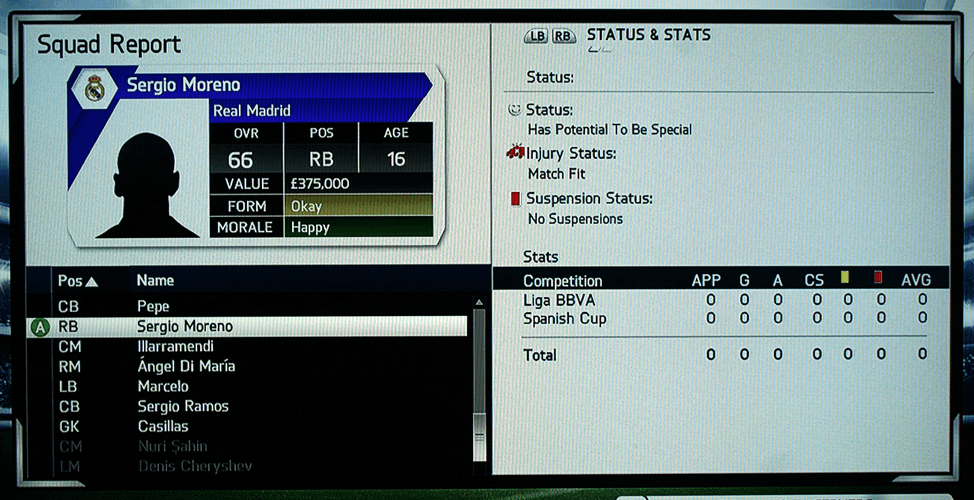
Now you see it…
However, here’s some big news – youth player potentials can change if you reload around the May update. For example, save the day before the May update. Advance, promote a youth player and his status may be “An exciting prospect”. Reload and do it again and this time it might be “Has potential to be special”. I’ve actually had a player who had “Showing great potential” one time, “Has potential to be special” another and then nothing at all on a third attempt. Usually it’s only going to be a small change – his potential going up or down by one point, most likely – but it’s interesting that it can be manipulated.
The impact of all this may not be massive – players can exceed their potential, after all, so he could reach amazing heights regardless of what his status is – but still, it’s something I’ve never seen before and is a fascinating thing to see.
Youth player values have also changed and there is potential for confusion. They are, generally, much lower than on FIFA 13. So if you go to promote a player and his value is only £50,000, for example, don’t despair. It doesn’t mean he’ll turn out to be useless, EA just seem to have toned it down a little this year.
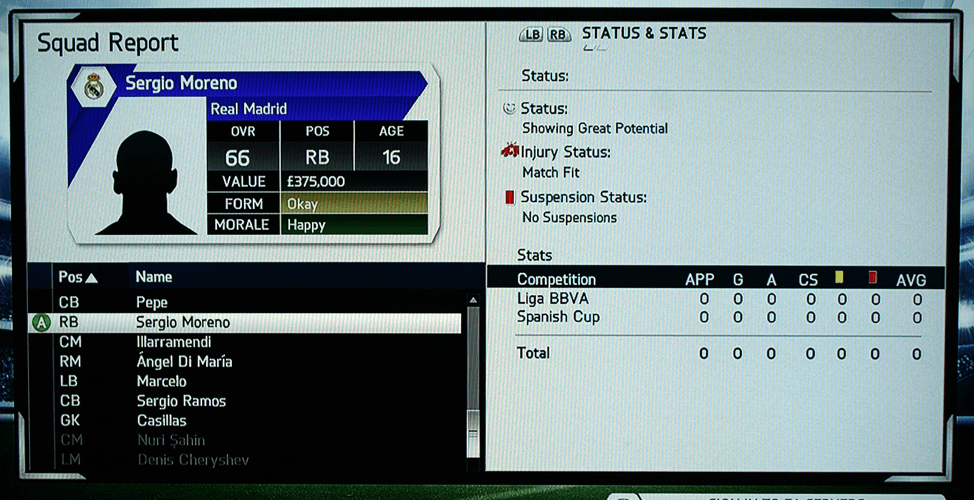
…now you don’t
Here’s a good example. In my test career I found a GK who came out of the academy rated 62 at age 16. Whilst in the academy he had a very promising potential range, yet when I went to offer him a contract he was only worth £110,000. However, I then went to the squad report page and, lo and behold, he had the ‘Has potential to be special’ status, meaning he could reach OVR 91+. On FIFA 13 players with that kind of potential would be valued at several million pounds when promoted, so EA have clearly reined that in a bit. So as I said, if you played FIFA 13 last year, forget everything about youth player valuations. This year it’s clearly different, so don’t release a load of youth products if their value is lower than you expected!
Interestingly, I found that goalkeeper with a 4*/5* scout whilst searching for playmakers! So you can get some nice surprises from time to time.
Scout a Future Star: user Patrick W pointed out that I had forgotten to mention the Scout a Future Star feature which you can buy from the EASFC catalogue. This basically sends out a scout to automatically bring back a player with extremely high potential, the type of player you only occasionally find in scouting trips. Patrick gave some great information so I’ll post what he said below:
When you use a Scout Future Star catalogue item, you will absolutely have to wait until 1 May of that season. The first one I used, I got a German ST, 55-59 OVR, 89-94 POT, who “wanted out” almost immediately. I signed him to the first team, and of course he was pretty bad, 58 OVR and extremely slow. Several seasons of loans later, and he’s still only a 68. My second Scout Future Star, however, I got a German RB, 42-44 OVR, 89-94 POT, who I kept in the youth squad all year. Come 1 May, he leapt up to 69-73 OVR. When signed to the first team, he was 72 OVR with 95+ sprint speed, accel, agility, and crossing. Three seasons later, he’s an 82 OVR complete forward who would be rated much higher if his position weren’t listed incorrectly (his low defending stats and high attacking stats suggest he definitely should be a RW or RM). So while it’s important for most youth players to keep them in the youth squad for as long as possible, it’s absolutely VITAL if you use Scout Future Star.
So it seems like a good idea to purchase the Scout a Future Star option sometime after January so that there’s not much time between the scout finding the player and 1st May. This means there’s less time for your future star to demand to be promoted early and therefore miss the May update!
Now here’s a roundup of some other useful information and ideas when scouting in FIFA 14:
- Regens do still exist, but of course you can’t see their OVR until you’ve sent a Global Transfer Network scout to go and have a look at them. This means it’s much harder to decide whether or not to sign a player; you can’t instantly see their OVR and know that they are worth signing. What I’d recommend is that you sort the free agents by position, then get your scouts to look at any positions that you feel you need strengthening
- If you get a message saying a youth player wants out of the academy, quit and reload (this is one reason why it’s important to save regularly). Next time, advance one day at a time (saving each time you advance and don’t get the message), and after an in-game week of doing this he may not ask to be promoted. This can require a lot of patience – sometimes it will take several goes – but eventually there will be a time when you don’t get the message and so shouldn’t risk losing him
- Playmakers can still have amazing mental stats and poor technical stats, but this seems to be rarer than in FIFA 13 (although it still happens annoyingly often)
- Youth players have different birthdays – I scouted one player who was 16 in the first report, then by the second report he was already 17. No other players my scout was looking at had increased in age. Not massively important, but it’s better than last year, when every youth player ever found would coincidentally be born on exactly the same day.
- EA seem to have finally addressed the ‘wrong-footed’ issue with scouted players (hallelujah!). In FIFA 13 you would very often find that your left-sided scouted players would be right-footed, and vice versa. This was extremely common and very annoying, especially when their weak foot was also poor. Thankfully EA seem to have cleared this up now – you can still get right-footed left-wingers, for example, which may be a good thing if that’s your playing style – but it’s much less common, making things much more realistic
- EA also seem to have sorted out the weight/height matching. I used to regularly find 6’5” beanpoles who weighed 145lbs, or 5’5” 200lb players who had clearly been fed too much ice cream. That’s pretty much non-existent now
- Finally, youth players can now have multiple positions. I know, it doesn’t mean much in practice (look at his stats to work out where he’s best, not his listed positions), but it’s a nice touch. The only slight hiccup is that goalkeepers can have multiple positions. Yep. Goalkeepers. I have one whose listed positions are GK/LM/ST. Good one, EA
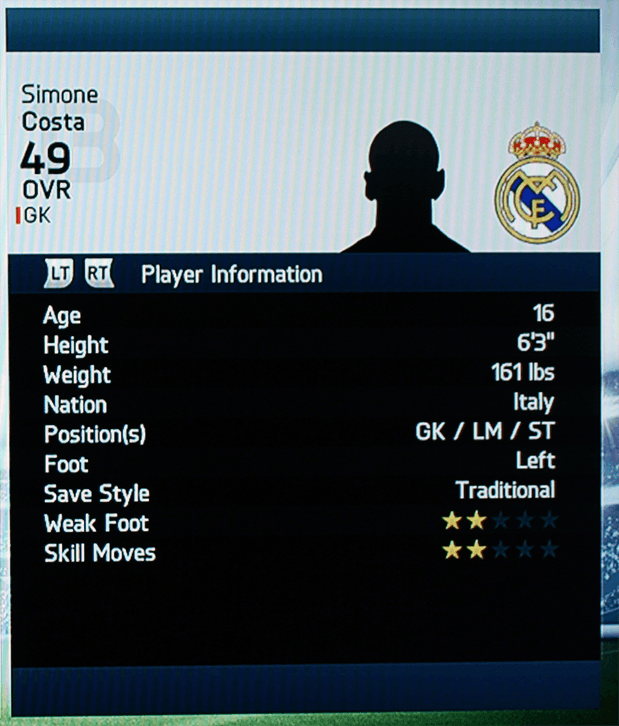
See? Didn’t believe me, did you?
Let’s have a look at what all this means to scouting in FIFA 14:
- Get the best scout you can. All scouts can find good players, but there is a noticeable difference between a 1*/1* scout and a 5*/5* one
- Some countries will give you a better chance of success than others, but all are capable of producing world-beaters. Bear in mind, though, that countries still don’t ‘specialise’ in player types
- It is now absolutely essential to look at player potential before OVR when reviewing your scouting reports. Players can grow enormous amounts in May, and if you have a player with a great potential range but poor OVR then you could be pleasantly surprised
- Reloading still works, so don’t despair if a scouting report brings back no notable players. Of course, you may feel this is cheating, so don’t do it if you don’t want to
- Wait until the May youth squad report to promote your youth players, otherwise you risk losing a year’s worth of growth
If you have any useful tips or want to share some of your scouting experiences, don’t forget to leave a comment below. Thanks for all your support and happy scouting!